
Hernia surgery
A hernia results from an imbalance between abdominal pressure and the weakening of the muscular wall. There are different types of hernia:
- Groin hernia: direct or indirect inguinal, femoral
- Umbilical hernia
- Epigastric hernia
- Post-operative or incisional hernia
What is a hernia?
With more than 150,000 operations performed each year in France, surgery for inguinal and femoral hernias and for incisional hernias is one of the most common surgical procedures.
A hernia is the protrusion of the peritoneum, the membrane that lines the abdominal cavity, sometimes together with a portion of the digestive tract, through an opening in the muscle layers of the abdominal wall. The clearest way to picture it is an inner tube bulging out through a split in a tyre.
It can appear at any age, in men as well as in women, and most often shows up as a localised swelling of the abdominal wall, which becomes more marked on exertion or when coughing.
How is it diagnosed?
Diagnosis is based above all on the clinical examination carried out by your doctor or your surgeon. An ultrasound scan of the abdominal wall is neither routine nor essential; it will only be requested in certain specific situations, at the doctor’s discretion.
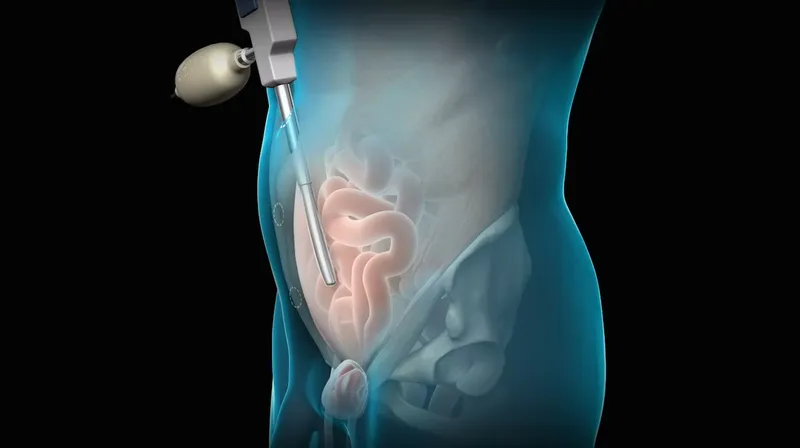
How is the operation carried out?
The surgical procedure
The aim is twofold: to put the hernia sac back into the abdominal cavity, then to close the defective opening by reinforcing the weak area.
There are two main techniques:
The conventional technique involves using surgical thread to suture the wall under tension. Although it still has a few specific indications, it is now increasingly being superseded by more modern methods.
The technique known as “tension-free”, without tension, uses a flexible prosthetic mesh that is lightweight and perfectly well tolerated by the body. It offers much greater post-operative comfort and a markedly lower recurrence rate. This is the technique we favour.
Two possible approaches
Once the technique has been chosen, the surgeon has two approaches available for placing the reinforcing mesh:
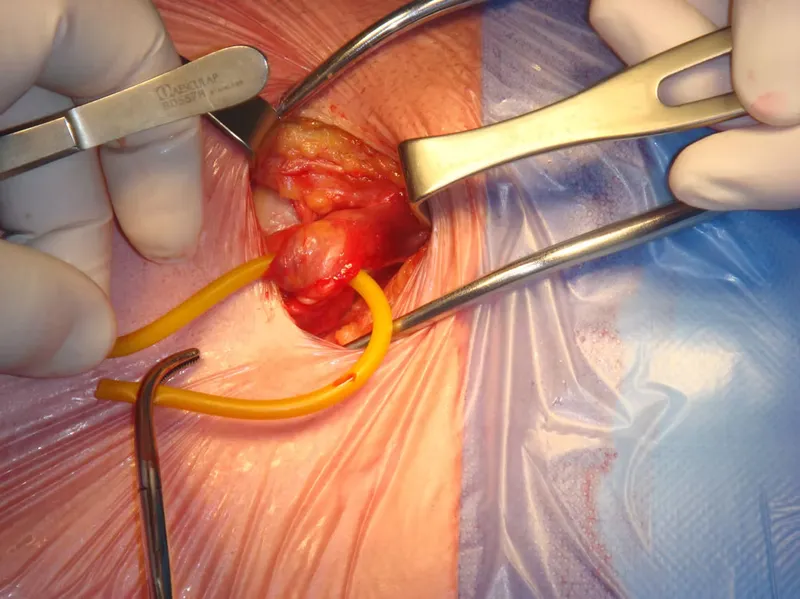
The open approach involves an incision of about 10 cm in the groin crease. This is the conventional approach, reliable and well established.
The laparoscopic approach is a minimally invasive alternative, performed through small incisions using a camera. Its advantage is that it is much less traumatic, particularly in terms of post-operative pain, and it allows a quick return to physical activities.
Our team mostly performs laparoscopic inguinal hernia repair. You must fast from midnight on the night before the operation. If you take medication every day, you must discuss this with your surgeon or a member of their team, who may want you to take some of your medication with a sip of water on the morning of the day of surgery. If you take aspirin, anticoagulants or anti-inflammatory drugs (for arthritis, osteoarthritis, etc.), you must discuss this with your surgeon and the anaesthetist, in order to set the date for temporarily stopping these medications before your operation.
Laparoscopic hernia repair is performed under general anaesthesia.
The principle of laparoscopic hernia surgery is to make 3 or 4 skin incisions of 5 mm, through which trocars are used to inflate the abdominal cavity with gas and to insert the camera and instruments into the preperitoneal space, in order to put the hernia sac back into the abdominal cavity and close the opening by reinforcing the weak area with a flexible prosthetic mesh. The operation takes about 20 to 30 minutes.
This operation is well standardised and commonly performed, but, as with any surgical operation, certain complications may occur: a reaction to the anaesthetic; bleeding; injury to an abdominal organ; orchitis (inflammation of one of the testicles); neuralgia (chronic pain along the course of a nerve). Local changes discovered during the operation or the occurrence of an unexpected complication may lead your surgeon to modify the operation initially planned, in order to do everything possible to deal with the difficulties encountered.
The laparoscopic approach may also be converted to a laparotomy (conventional surgery leaving a large scar). The list of complications described is not exhaustive, but it is important to understand that one of the aims of the pre-operative consultation is to allow your surgeon to weigh the risks you would take by not having the operation against the risks inherent in surgery. If surgery has been recommended, it is most likely because, unlike in cosmetic surgery, postponing it would carry more risk.
If you have any doubts, do not hesitate to ask your surgeon for more information. As for post-operative incidents, swelling in the area of the former hernia, which is usually temporary, may appear after the operation. This is generally a seroma, that is, a pocket of fluid in the empty space that the hernia used to occupy. It subsides within a few weeks. If it persists, do not hesitate to mention it. Another post-operative incident specific to laparoscopic surgery may appear from the day after the operation: sharp pain in the shoulders linked to the gas used for the laparoscopy.
This pain always disappears within 24–48 hours.
Post-operative advice
Patients usually stay in hospital for 24 hours before going home. Same-day surgery, with discharge on the day of the operation, is also possible. Patients can drink on the evening of the operation and eat normally from the next day, without restriction. There is no need for a convalescent home, except in particular cases.
In most cases, this operation causes little post-operative pain, which responds well to the simple painkillers that will be prescribed when you leave hospital. Patients are encouraged to resume very light activity once they are back home from hospital, while avoiding driving for about 5 days. The patient is asked to attend the post-operative consultation, generally 1 month after the date of the operation.
The length of time off work, from 1 to 4 weeks, is to be discussed at the pre-operative consultation, taking into account each patient’s particular situation and the nature of their work. Sport can generally be resumed 1 month after the operation.
Frequently asked questions about hernia surgery
In addition to the post-operative check-ups you have been told about, it is essential that you contact your doctor if you notice, for example, any of the following: persistent fever; chills; bleeding; increasing swelling of the abdomen or increasing pain; persistent nausea or vomiting; a persistent cough or difficulty breathing; persistent difficulty swallowing food; fluid oozing from any incision.
It all depends on your general health, your physical activities, your own wishes, of course, and the type of anaesthesia you prefer. There are two schools of thought, but the two methods are equivalent in terms of the strength of the wall repair. Both involve placing a prosthesis or mesh: this is a kind of fabric, rather like mosquito netting, which, once incorporated into your wall, makes it stronger.
In the past, mesh was rarely used, which led to many hernia recurrences. Since it has been used almost routinely, the recurrence rate has fallen considerably. Finally, laparoscopic hernia repair requires general anaesthesia, which is not necessarily the case with what is known as traditional surgery. The choice of technique will therefore be made with your surgeon, taking all these criteria into account.
You will be asked not to put too much strain on your wall for about a month. However, a gradual and gentle return to activity is advised fairly soon after the operation.
Rest assured, this is what we call a seroma; let me explain. Nature abhors a vacuum, and where the hernia used to be… there is nothing left, so nature tries to fill this “empty space” with fluid secretions, creating this famous seroma (a “ball of fluid”). In most cases, the seroma disappears on its own, gradually, within a few days to a few weeks.