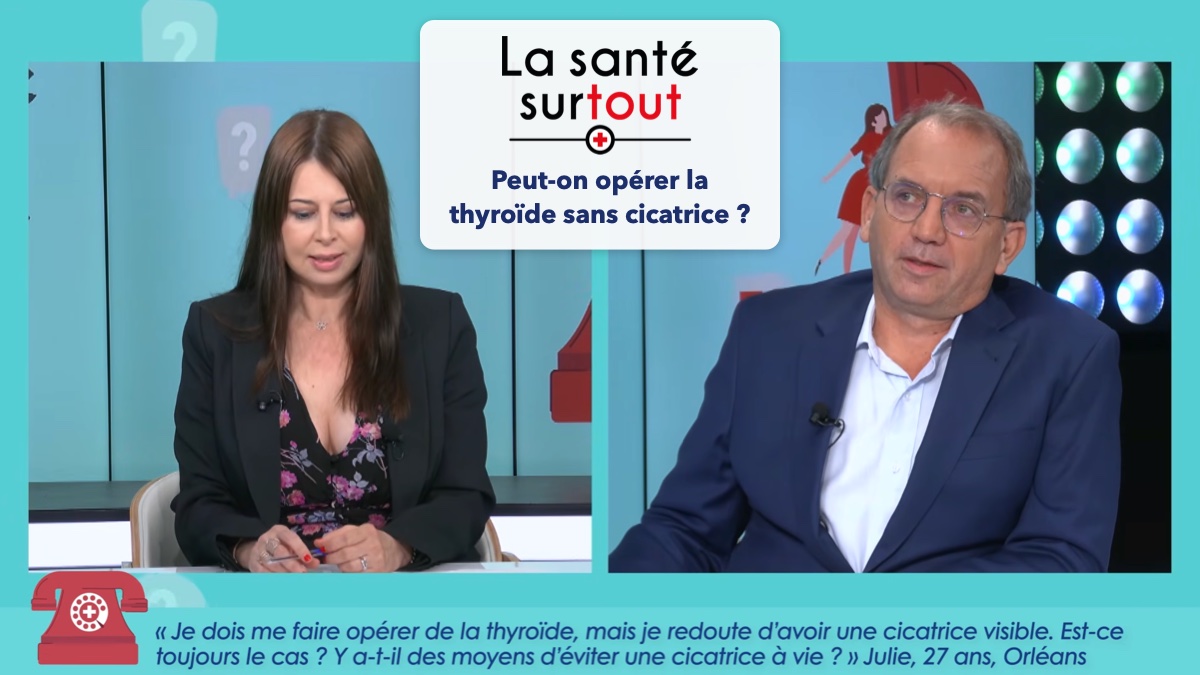
“I need to have thyroid surgery, but I dread having a visible scar. Is that always the case? Are there ways to avoid a lifelong scar?” This is the question asked by Julie, 27, from Orléans, on the programme La Santé Surtout !. This fear is common, and the neck scar is no longer inevitable. A thyroid operation without a neck scar is now possible thanks to surgery via the transoral approach.
Excerpt from the Doctissimo TV programme La Santé Surtout ! (in French), presented by Jessyca Falour.
Why does the neck scar cause concern?
Conventional thyroid surgery, called cervicotomy, is performed through a horizontal incision at the base of the neck, above the sternum. The scar is therefore in the middle of the neck, in an exposed place. Over time, it usually fades, but it remains visible. Yet in social interactions, a visible scar on the neck can catch the eye. Transoral surgery makes it possible to avoid it.
How is the thyroid operated on through the mouth?
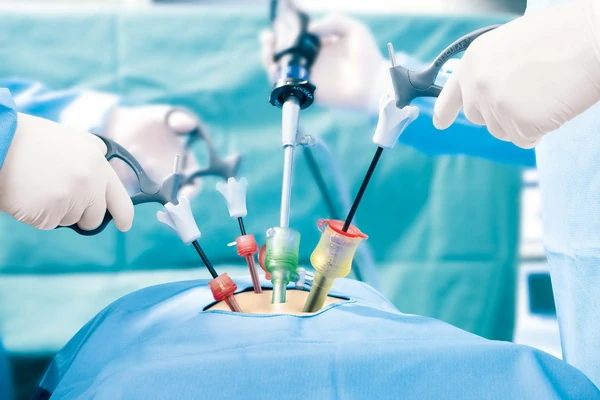
The technique is called transoral endoscopic thyroidectomy via the vestibular approach, or TOETVA. We go in just behind the lower lip, through three small incisions, using video-endoscopic surgery.
The instruments pass behind the chin and travel under the skin to the thyroid. The thyroid is dissected and then removed, without any incision on the neck. The procedure is performed under general anaesthesia, like a conventional operation.
Where does this technique come from?
Transoral surgery has been extensively developed in Asia, partly for cultural reasons: many Asian patients do not want the Yin meridian to be cut by a neck scar.
I trained directly on site, in Bangkok, in 2018, and then brought this technique back to France. Since then, I have performed more than 400 procedures using this approach. Asian teams, for their part, have performed thousands. In fact, I presented my experience at the international congress of transoral thyroid surgery in Bangkok.
Is it as safe as a conventional operation?
It is a published and recognised technique, which carries no more risk than cervicotomy if it is performed well, that is, by a team trained in thyroid surgery and in this approach, in a well-selected patient.
The risks are those of any thyroid surgery, particularly for the voice and for calcium. In addition, there are after-effects specific to the transoral approach, such as pain in the neck and chin or reduced sensation in the lip or chin, which generally last from a few days to a few weeks. All these points are explained in detail during the consultation.
Can a scar be seen after the operation?
No, there is no scar on the neck. The three small incisions are inside the mouth, behind the lower lip, where they are hidden.
Is the transoral approach possible for everyone?
No. It is possible for most thyroid diseases, including some small cancers. It is not suitable for very large goitres, that is, very enlarged thyroid glands, nor for certain diseases depending on their type.
The choice of technique is made in consultation, based on the ultrasound and the full assessment, also taking your wishes into account. The transoral approach is an option, and the conventional operation remains a proven technique. Before considering an operation, it is in fact necessary to make sure that it is needed, because many nodules are not operated on. I explain this in the article Thyroid nodule: should it be operated on? And for some benign nodules that are troublesome, thermal ablation, without surgery, can be an alternative.
Frequently asked questions
Is the operation through the mouth painful?
Pain in the neck and chin is possible in the early days, as well as reduced sensation in the lip or chin. These ease within a few days to a few weeks.
Can thyroid cancer be operated on via the transoral approach?
For some small cancers, it is possible. The decision depends on the assessment, in particular on the size of the tumour and the condition of the lymph nodes, and is made on a case-by-case basis.
What is monitored after the operation?
As after any thyroid surgery, we monitor the voice, the calcium level, pain and swallowing, as well as healing inside the mouth.
How can I find out whether I can benefit from it?
You need an examination during a consultation, a recent ultrasound scan and a blood test. You can book an appointment from the Contact page or, if you live far away, request a second opinion teleconsultation.
Dr Grégoire Deroide
Going further
To find out all about how the procedure is carried out, see the Scarless thyroidectomy (TOETVA) page, as well as the Thyroid surgery page.
See also:
- Thyroid nodule: should it be operated on?
- Treating a thyroid nodule without surgery
- High calcium: think of hyperparathyroidism
This information is general and does not replace a medical consultation.