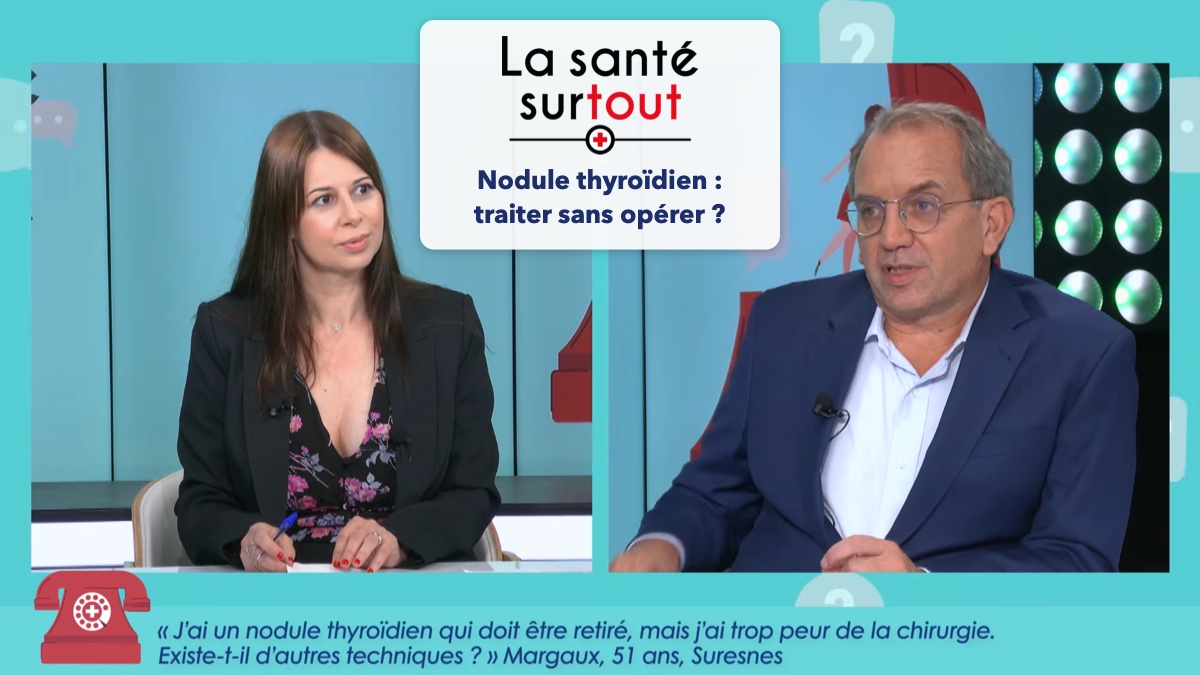
“I have a thyroid nodule that has to be removed, but I am too afraid of surgery. Are there other techniques?” This is the question asked by Margaux, 51, from Suresnes, on the programme La Santé Surtout !. The answer is yes. There are known techniques, which are being used more and more at the moment, for treating some thyroid nodules without a scalpel and without a scar. The main one is thermal ablation.
Excerpt from the Doctissimo TV programme La Santé Surtout ! (in French), presented by Jessyca Falour.
What is thermal ablation of a thyroid nodule?
Thermal ablation involves destroying the nodule with heat, from the inside. We use a slightly thicker needle, inserted as for a fine-needle aspiration. Guided by ultrasound, it is placed in the nodule. With small movements, we gradually destroy the tissue of the nodule.
Depending on the technique, the heat is produced by radiofrequency or by laser. Unlike with surgery, the thyroid is preserved: only the nodule is treated.
What happens during a session?
Before the procedure, we check that the nodule is benign, that the vocal cords are working normally and that there is no clotting disorder.
Thermal ablation is performed under local anaesthesia, without general anaesthesia. The procedure is entirely guided by ultrasound, which makes it possible to follow the position of the needle in the nodule in real time. There is no incision and no scar, and you generally go home the same day.
What results can be expected?
The nodule does not disappear on the same day. The heated and destroyed tissue is gradually eliminated by the body. The volume of the nodule therefore decreases slowly, by about 60 to 80% at one year. The problems it causes decrease in parallel.
A treated nodule can sometimes grow back and require a second session. Follow-up relies on check-up ultrasound scans.
For which nodules is thermal ablation indicated?
Thermal ablation is obviously only performed if the fine-needle aspiration is negative, that is, if it has shown that the nodule is benign. Fine-needle aspiration is used precisely to decide on the treatment of a nodule. A suspicious or cancerous nodule calls for a different treatment.
It is particularly useful for benign nodules that cause problems, for example a deformity of the neck, in patients who prefer to avoid surgery.
Thermal ablation or surgery: how to choose?
The choice is made on a case-by-case basis, in consultation. Thermal ablation avoids general anaesthesia and the scar, and preserves the thyroid. Surgery removes the nodule in one go and allows it to be analysed in full under the microscope. It remains necessary for a suspicious or cancerous nodule, and may be preferred for some very large nodules.
For a mainly fluid nodule (a cyst), ethanol ablation is generally offered first: the cyst is emptied, then alcohol is injected into it.
Is thermal ablation reimbursed?
At the time of the broadcast, its coverage by the Assurance Maladie was being put in place, but thermal ablation was not yet fully reimbursed. The cost that remains for you to pay is specified before the procedure.
Who performs thermal ablation?
Three specialties can perform it, after specific training: interventional radiologists, endocrinologists who perform a lot of thyroid ultrasound and their own fine-needle aspirations, and thyroid surgeons.
My practice is devoted to the thyroid and parathyroids, and I offer fine-needle aspiration, thermal ablation and surgery. I think it is useful to consult a practitioner who has mastered all of these techniques, so that you can choose together the one that suits your nodule.
What if an operation is still necessary?
Being afraid of surgery is legitimate. When thermal ablation is not suitable, an operation may be offered. In many cases, it can be performed without a scar on the neck, via the transoral approach.
Frequently asked questions
Is thermal ablation painful?
It is performed under local anaesthesia. Discomfort or a feeling of heat in the neck may be felt during the session and in the following days.
Is a fine-needle aspiration needed before thermal ablation?
Yes, always. Thermal ablation is only offered if the fine-needle aspiration has shown that the nodule is benign.
Does it leave a scar?
No. The treatment is carried out with a simple needle puncture guided by ultrasound, with no incision and no scar.
Does the thyroid work normally after the treatment?
Generally, yes: only the nodule is destroyed and the rest of the thyroid continues to work. Thyroid dysfunction after thermal ablation is very rare. A check-up blood test is part of the follow-up.
Dr Grégoire Deroide
Going further
For the techniques that make it possible to preserve the thyroid, including radiofrequency, read the article Saving your thyroid. The article Thyroid ultrasound presents the standard examination for nodules. You can book an appointment from the Contact page.
See also:
- Thyroid nodule: should it be operated on?
- Having thyroid surgery without a scar
- High calcium: think of hyperparathyroidism
This information is general and does not replace a medical consultation.