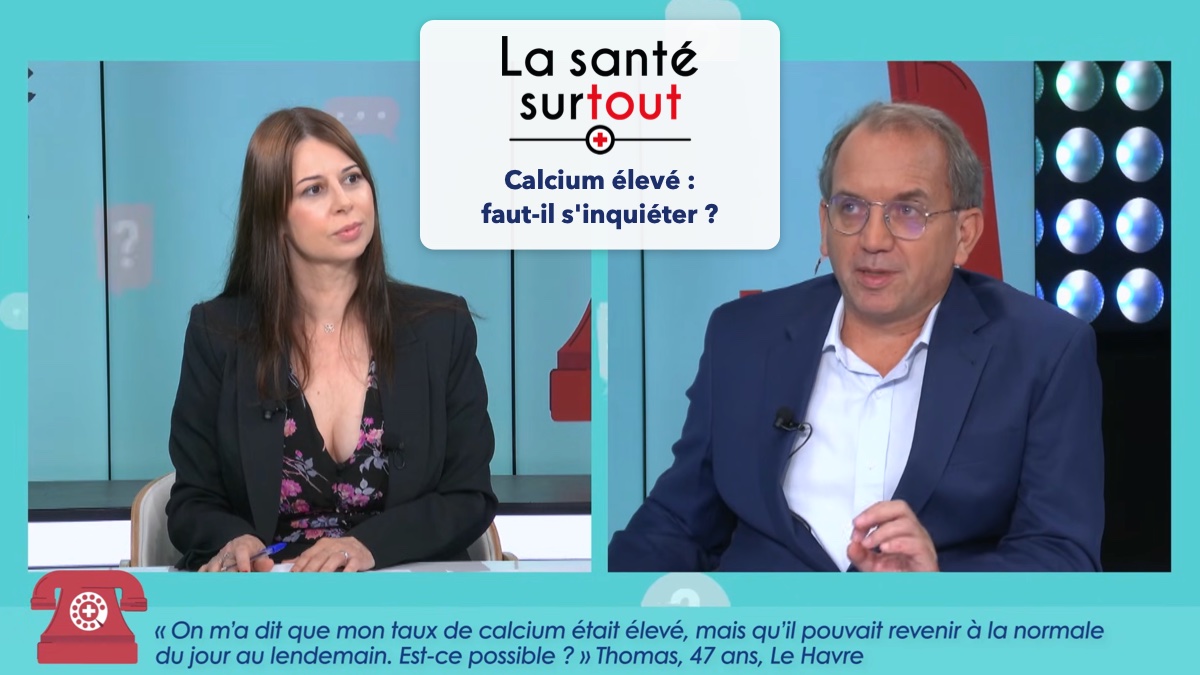
“I was told that my calcium level was high, but that it could return to normal overnight. Is that possible?” This is the question asked by Thomas, 47, from Le Havre, on the programme La Santé Surtout !. High calcium is not normal. Even if it is only slightly high, it is absolutely necessary to have an assessment, because it often reveals a disease of the parathyroid glands, hyperparathyroidism.
Excerpt from the Doctissimo TV programme La Santé Surtout ! (in French), presented by Jessyca Falour.
Can high calcium return to normal on its own?
For many blood test values, such as sodium or potassium, we sometimes simply say “we’ll check it again”. For calcium, this is not the right thing to do. Even if it is only slightly high, it must lead to an assessment. A normal repeat test is not enough to rule out a disease, because in hyperparathyroidism calcium can vary from one blood test to another.
What assessment should be done if calcium is high?
The basic assessment is simple. Calcium and PTH (parathyroid hormone) need to be measured, ideally in the same blood test. Vitamin D is usually measured as well, because a lack of vitamin D can also raise PTH.
The endocrinologist then rules out the few other causes of raised calcium.
What is hyperparathyroidism?
When calcium is high, in 90% of cases you have to think of a diagnosis that is a little “à la Dr House”: hyperparathyroidism. It is a disorder of the parathyroid glands, small glands located behind the thyroid, which regulate the level of calcium in the blood.
In 80% of cases, only one of these glands starts to secrete too much PTH. It then disrupts calcium balance and causes hypercalcaemia, that is, an excess of calcium in the blood. The gland responsible is enlarged by a parathyroid adenoma, a small benign tumour, almost all the time.
What are the symptoms of hyperparathyroidism?
The signs are varied, which makes this disease clinically fascinating, but also difficult to recognise:
- bone, muscle and joint pain
- heart disorders (rhythm disorders, left ventricular hypertrophy, or even high blood pressure)
- and above all, chronic fatigue
Hyperparathyroidism can also contribute to kidney stones and osteoporosis. Today it is often discovered on a simple blood test, even before obvious symptoms appear.
How is hyperparathyroidism treated?
The treatment is surgical. It consists of removing the parathyroid adenoma. Before the operation, imaging tests (neck ultrasound, nuclear medicine scan) usually make it possible to locate the diseased gland, which often means it can be removed on its own, through a small incision. You will find a detailed description of the procedure on the Parathyroid surgery page.
Most symptoms are reversible after removal of the adenoma. This is not always the case, but it is very often the case, and the operation can then bring patients great relief.
Why is the diagnosis often made late?
Calcium and PTH are still rarely measured in routine blood tests. Some people therefore live with this disease for 5 or 10 years before the diagnosis is made.
This is a message I am keen to get across. If your doctor does not think of it, you can suggest that they measure calcium and PTH.
Why measure calcium before thyroid surgery?
The parathyroids are located just behind the thyroid, and the endocrine surgeon operates on these two glands. This is also why calcium is measured before thyroid surgery. Associated hyperparathyroidism can thus be detected and treated at the same time. If you also have a thyroid nodule, these articles may interest you: should a thyroid nodule be operated on?, treating it without surgery by thermal ablation and having thyroid surgery without a neck scar.
Frequently asked questions
What is PTH?
PTH, or parathormone, is the hormone produced by the parathyroid glands. It regulates the level of calcium in the blood and is measured with a simple blood test.
My calcium is only slightly high: should I be worried?
You should not panic, but you should not ignore it either. Even if it is only slightly high, a calcium level must lead to an assessment, with PTH measurement.
Is hyperparathyroidism a cancer?
Almost never. It is most often due to an adenoma, a small benign tumour of a parathyroid gland.
Which doctor should I see?
Your family doctor can prescribe the tests. The endocrinologist confirms the diagnosis and rules out the other causes. The endocrine surgeon performs the operation when it is indicated.
Dr Grégoire Deroide
Going further
To find out more, see the Parathyroid surgery page and the Hyperparathyroidism article. You can book an appointment from the Contact page.
See also:
- Thyroid nodule: should it be operated on?
- Treating a thyroid nodule without surgery
- Having thyroid surgery without a scar
This information is general and does not replace a medical consultation.