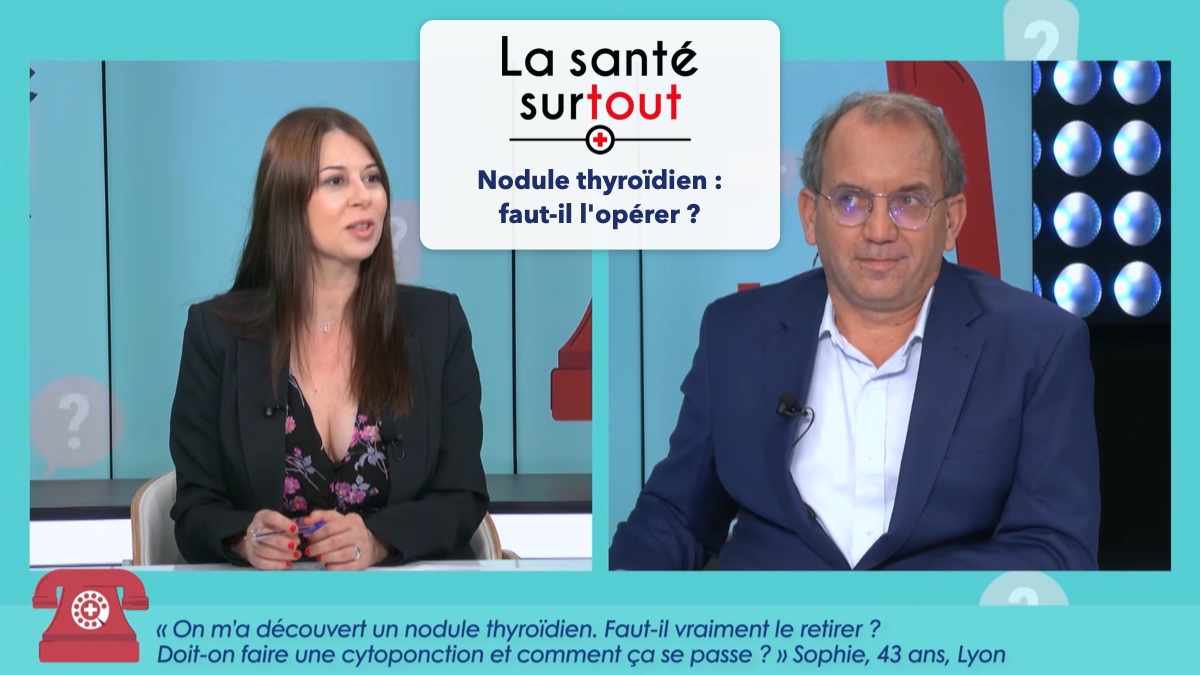
“I was found to have a thyroid nodule. Does it really need to be removed? Does a fine-needle aspiration have to be done, and what does it involve?” This is the question that Sophie, 43, from Lyon, asked on the programme La Santé Surtout !. To begin with, I want to reassure her. In the vast majority of cases, a thyroid nodule is not a disease, and it should not be operated on. On the other hand, the nodules that need to be investigated or treated must be recognised.
Excerpt from the Doctissimo TV programme La Santé Surtout ! (in French), presented by Jessyca Falour.
Is a thyroid nodule serious?
In the vast majority of cases, no. Nodules are most often discovered by chance, on an ultrasound scan, a CT scan or a test requested for a completely different reason. Thyroid nodules are very common and the great majority of them are benign. Having a nodule is therefore not a disease in itself.
The right thing to do is to characterise it before thinking about removing it. What does it look like, how big is it, is it troublesome, is it producing too much hormone?
What do we look at on ultrasound?
It is the ultrasound scan that makes it possible to measure the nodule and describe its appearance. Ultrasound specialists summarise this appearance with a score, the TIRADS classification (in Europe, EU-TIRADS), which ranges from 2 to 5: the higher the score, the more suspicious the nodule. This score, together with the size, guides all the subsequent management. If it is not on your report, ask for it. The ultrasound scan also looks for any abnormal lymph nodes in the neck.
The assessment also includes a blood test, with TSH measurement, which shows whether the nodule is producing too much thyroid hormone.
Should a thyroid nodule be operated on?
Three questions guide the decision whether or not to treat:
- What does it look like? A nodule that is suspicious on ultrasound must be investigated with a fine-needle aspiration.
- Is it troublesome? It can interfere with swallowing, or be a cosmetic problem when it deforms the neck.
- Is it producing too much hormone? It can then cause hyperthyroidism.
Outside these situations, a silent nodule is not operated on and is not treated. It is simply monitored with ultrasound scans spaced out over time.
When should a fine-needle aspiration be done?
Fine-needle aspiration is not routine. It is indicated according to the appearance of the nodule and its size:
| EU-TIRADS score | Appearance of the nodule | Fine-needle aspiration at or above |
|---|---|---|
| 5 | Very suspicious | 10 mm |
| 4 | Moderately suspicious | 15 mm |
| 3 | Slightly suspicious | 20 mm |
| 2 | Benign | No fine-needle aspiration |
Below these thresholds, ultrasound monitoring is usually enough. Ultrasound suspects, and fine-needle aspiration decides whether or not treatment is needed.
What does a fine-needle aspiration involve?
It is a test that takes about ten minutes and can avoid many unnecessary operations. Under ultrasound guidance, a very fine needle takes a few cells from the nodule, which are then analysed under the microscope. The procedure is done without general anaesthesia, it is not very painful and you leave straight away.
The result is classified on an international scale, the Bethesda classification: from a benign nodule to a malignant nodule, via intermediate results that may require the sample to be repeated.
Next, should the nodule be monitored, treated without an operation or operated on?
Depending on the result of the fine-needle aspiration, how troublesome the nodule is and how it functions, several options are possible:
- A benign nodule that is not troublesome is monitored by ultrasound, without treatment.
- A benign but troublesome nodule can be treated without a scalpel, by thermal ablation of the thyroid nodule.
- For a suspicious or cancerous nodule, or a troublesome nodule that cannot be treated any other way, surgery is offered. In many cases, it can be performed without a scar on the neck, via the transoral approach.
- For a nodule that secretes too much hormone, the treatment is discussed with the endocrinologist.
These decisions are made with you, in consultation with your family doctor and your endocrinologist, according to your situation and your preferences.
Frequently asked questions
Is a thyroid nodule often cancer?
No. The great majority of nodules are benign. The role of ultrasound, and then of fine-needle aspiration when it is indicated, is precisely to identify the rare suspicious nodules.
Is fine-needle aspiration painful?
It is not very painful, comparable to a blood test. The needle is very fine and the procedure only takes a few minutes.
Does a benign nodule need to be monitored?
Yes, but not excessively. Ultrasound scans spaced out over time are enough, at a frequency set by your doctor according to the appearance of the nodule.
I have been offered an operation: can I ask for a second opinion?
Yes, that is legitimate. You can discuss it with your doctor, or request a second opinion teleconsultation, attaching your ultrasound and the result of your fine-needle aspiration.
Dr Grégoire Deroide
Going further
To find out more about the management of nodules and goitres, see the Thyroid surgery page and the Thyroid ultrasound article. You can book an appointment from the Contact page.
See also:
- Treating a thyroid nodule without surgery
- Having thyroid surgery without a scar
- High calcium: think of hyperparathyroidism
This information is general and does not replace a medical consultation.