Historically, this technique was developed in Korea by Prof WY CHUNG, because the presence of a neck scar is very poorly accepted in Asian culture.
It involves moving the neck scar to the armpit and accessing the thyroid region through skin undermining and an incision of 5 to 6 cm.
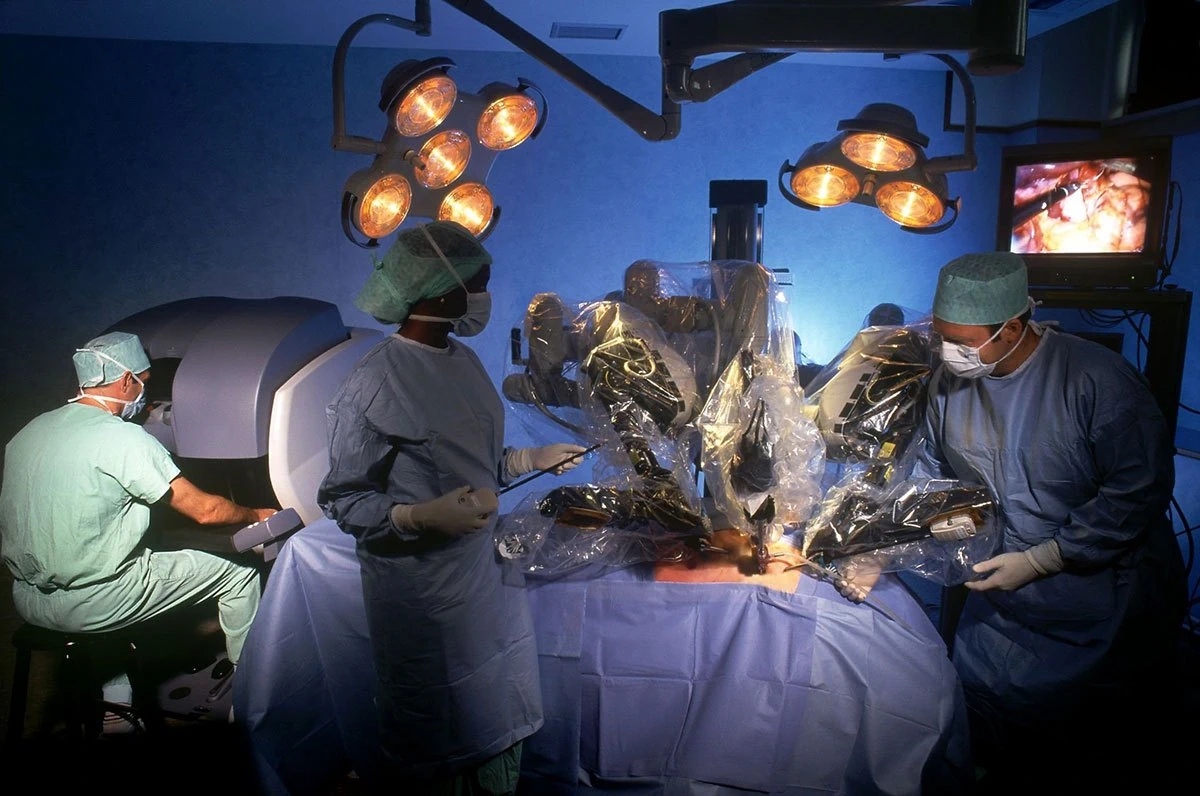
The surgeon then guides the instruments of the da Vinci robot through the “subcutaneous tunnel”. The robotic technique makes it possible to manipulate the instruments more precisely in three dimensions in the patient’s neck.
Dr DEROIDE holds the DIU in ROBOTICS from NANCY. He was trained by Dr Patrick AIDAN, Head of Department at the American Hospital of Paris, who is one of the first to have developed the technique in France (more than 200 cases).
WHAT ARE THE BENEFITS?
First, the cosmetic aspect: no neck scar. The scar is moved to the armpit.
Next, there is less pain and fewer swallowing disorders post-operatively. The return to work is therefore earlier.
Finally, the robotic technique offers greater working comfort for the surgeon and the patient: better ergonomics, high-definition optics that magnify the view 8 times, high precision of the dissection.
WHEN TO OPERATE?
The indications are the same as in conventional surgery.
The limit is essentially the size of the thyroid:
- nodule smaller than 7 cm
- small to medium goitres
- Thyroid cancer: depending on the size and type
WHAT ARE THE RISKS?
The risks are broadly the same as in conventional surgery.
Dr Grégoire Deroide
See also: Thyroid surgery · Scarless transoral thyroidectomy (TOETVA)